Showing posts with label H Bonds. Show all posts

Wednesday, June 25, 2025

How 10 CCAs Were Bigger than China in 2024

A dozen years of work with San Francisco,  Marin, and Sonoma County, including partnerships with Los Alamos National Laboratory and the California Energy Commission, spawned a Revolution in Power that has replicated massively ever since. We could not be more pleased.

CCA 2.0, which combines the aggregation of energy demand with Green Bonds, is already out-investing China and Canada in the massive Green Bonds realm since Local Power, creator of California's CCA 2.0 model, wrote the landmark Green Bond Authority as part of this new model in 2001. 

The California Community Choice Financing Authority has issued $6 billion in 2024, with a significant uptick in the past 12 weeks, cementing its place as the 10th biggest green bond issuer in the world—larger than either the governments of China or Canada, as reported last week in Bloomberg. helping green bond sales approach previous records. That made US the largest issuer, too! 

Local Power developed the CCA 2.0 model as a way to scale and accelerate climate action while avoiding rate increases for consumers. California CCAs have maintained competitive rates while issueing $15B in Green Bonds and leveraging $20-25B in private financing, approaching $40B in investment in renewables in California and the West and creating over 25,000 jobs. 

By inventing this model, Local Power LLC has proven right: a scaled, accelerated demonstration of the power of municipalities, independent of federal politics, to implement climate action on a global scale, without increasing costs to consumers, through local power and local action. CCA 2.0 is now record-smashing.

In California, the California Community Choice financing Authority (CCCFA) has implement Local Power's CCA 2.0 program design, copying Local Power LLC's groundbreaking work for San Francisco (CleanPowerSF), Marin County (Marin Clean Energy) and Sonoma County (Sonoma Clean Power) from 2001 to 2014 to use CCA to leverage Green Bond financing of new renewable energy facilities to the tune of $15 billion dollars. In California CCAs procure power for more than 14 million customers—over a third of the state's population. Two hundred cities and and counties throughout the state have amassed a total of 346 long-term power purchase agreements adding about 18 MW of new-build renewable energy resources, including over 10,000 MW in renewable energy and over 7500 MW of energy storage. PPAs range from 10 to 27 years in length and average 16 years across all agreements. CCAs  tax-exempt status to lower interest rates and energy costs. 

The California Community Choice Financing Authority (CCCFA), a public agency formed to help CCAs finance clean energy purchases, uses “green bond” prepayment transactions. This approach can reduce CCA PPA costs by 10 percent or more. 

CCCFA has ten CCAs as members - under half of the two dozen CCAs in the California. CCCFA has issued $16 billion in prepayment bonds, equating to savings of approximately $100 million per year for community choice customers or nearly $3 billion over the lifetime of the contracts. according to CCCFA. For reliability, in the past year CCAs  invested  in both stand-alone and co-located energy storage with various technologies including lithium-ion batteries, vanadium redox flow batteries, and compressed air energy storage. CCA providers have also procured 617 MW of long duration storage with an eight-hour discharge capability to help stabilize the grid.

Interest is growing in our latest, newer business model under development for the past decade and now coming to market outside California: CCA 3.0: Climate Mobilization. This is CCA for decarbonizing all addressable carbon sources, and based not only on Green Bonds and third party financing, but on direct investment by customers based on local finance, cooperation and sharing. This is a new level of energy transition beyond even California's great leap beyond even the gargantuan scale of China! Its secret weapon is: an ownership model based on the energy user. 

To learn more about Local Power's Green Bond work, click here

To learn more about Local Power's creation of CCA 2.0 in California, click here

Saturday, June 1, 2024

Local Power's CCA Green Bonds Model Delivers The Largest Issuance of Green Bonds in the U.S.

CCA added to Green Bonds delivers a whole new level of CCA climate fire power. We estimate that CCA 2.0, which is defined by the combination of renewable wholesale CCA and Green Bonds, is 20-50x more powerful a climate impactful model than CCA 1.0 in Massachusetts, site of the first aggregation to use state energy efficiency funds. But the scale and per capita reach of CCA 2.0 in California is an exponential leap, delivering over $30B of investment in local and mostly in-state renewables compared to CCA in Massachusetts, where the focus has been Renewable Energy Certificates (RECs) and pilot projects. While we have received less acclaim for creating Green Bonds than we have for creating CCA, we consider it just as prideworthy and important - not just Green Bonds in general, but the specific kind of Green Bond we articulated and/or won approval for in San Francisco, Marin, Sonoma County, East Bay and dozens of other CCAs during their formation between 2000 and 2010. Most of them held back, for over a decade. Until now, and the impact is needless to say, epic.

Thanks are due to Howard Golub and bond counsel of Nixon Peabody for providing revenue bond expertise to Local Power's work on the H Bond model to augment the CCA program in 2005; also to Bradley Turner and his team at Booz Allen Hamilton, and Local Power first employee Robert Freehling's early work with Local Power, David Erickson, Chris Kiriakou, Charles Schultz and Sam Golding, who all contributed important work in various stages of its articulation to H Bond integration with California's formative CCAs.

Local Power authored the landmark CCA H Bond program with San Francisco voter approval of the bond in 2001 and San Francisco Board of Supervisor approval of the authority to issue CCA bonds in 2004, and the Community Choice Aggregation, H Bond Action Plan in 2007, the “In City Buildout Plan” including bond counsel in 2009,  and “In City Buildout Business Case” in 2013, including a full profits and loss sheet for a ten year operation, and including the use of the Green Bond or "H Bond" Authority.

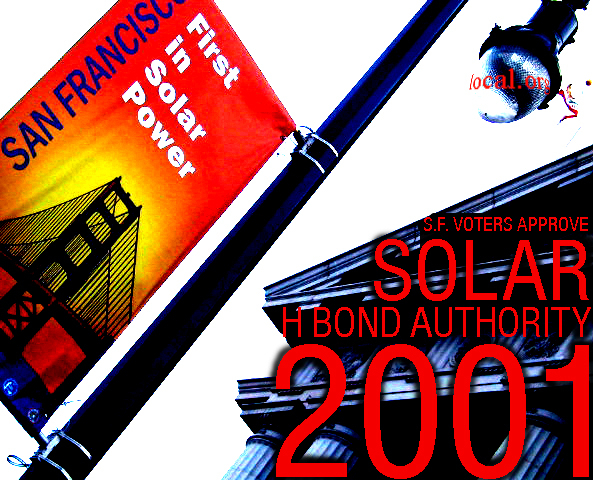
The voter approved revenue bond authority in 2001 in the form of a city charter amendment (Section 9.107.8), known as the "solar bonds," authorized the City of San Francisco to finance renewable energy and energy conservation measures on homes, businesses and government buildings. The campaign for solar bonds, Proposition H, was motivated by the need for the city to take meaningful action on climate change beyond financial instruments like RECs, by building and installing renewable generation and efficiency. We proposed the same structure to Main Clean Energy in 2009 and Sonoma County in 2013. The solar bond authority was used as part of the city's renewable energy program, administered by the San Francisco Public Utilities Commission, CleanPowerSF, with bonds first issued in 2012. 

The California Community Choice Financing Authority, which helped organize a group of California CCAs in California to issue Green Bonds through their platform, is responsible for the largest issuance of Green Bonds in the United States!

Community Choice Aggregation is allowed in half of the US energy market, dominates the electricity industry in several states and serves one in ten Americans. Most of California is served by CCAs, its CCA 2.0 is being absorbed by the 1.0 programs across the rest of the country, and New York State is on the verge of another Big Leap in climate impactfulness beyond even CCA and Green Bonds, by engaging neighbors in shared systems, CCA 3.0. We anticipate that CCAs in California will ultimately go even further and beyond the supply side paradigm so many still follow, into a new territory of customer ownership, cooperation, local job creation and local economic development.

Tuesday, March 28, 2023

H Bonds Finally Realized: California CCAs issue $5 Billion in Solar Bonds

In addition to founding Community Choice Aggregation, Local Power has long boasted of our founder's invention of the Solar Bond or Green Bond ("H Bond" from Proposition H, the original bond authority adopted by San Francisco Voters in 2001). However, we have long been frustrated by the how very long it has taken CCA programs in the Bay Area and California to implement H Bonds. Climate change does not forgive slowness, and neither do we. 

As we have been telling CCA leaders for over nearly two decades, the buying power of municipal aggregation must combine with municipal financing through revenue bonds to transform a CCA into something much, much more powerful. From 2008 when Marin Clean Energy chickened out, and then San Francisco Supervisors lost their courage in 2013, we were afraid CCAs would never see the light. 

But finally, this past week, Local Power's leadership finally paid off - however belatedly - with the announcement of the issuance of $5 Billion in revenue bonds by CCAs to build renewable energy in California. The "Clean Energy Project Revenue Bond" is a renamed H Bond, the original CCA revenue bond authority written by Local Power and adopted by San Francisco in 2001. Local Power drafted San Francisco's CCA law to combine CCA with revenue bonds for the first nearly twenty years ago, in 2004. Since then, only San Francisco had ever used the authority. But now the H Bond, like CCA itself, has hit prime time. Five billion dollars is very big news indeed: the level of big we have long awaited. Climate change scale: community wide scale.

California CCAs East Bay Community Energy, MCE, Silicon Valley Clean Energy, Pioneer Community Energy, and Clean Power Alliance have all issued clean energy revenue bonds, claiming to save an estimated $840 million for California electricity customers over the next 30 years. Each of the CCAs entered into a long-term power supply agreements for sources like solar, wind, geothermal, and hydropower. The municipal revenue bond or H Bond issuer – in this case, California Community Choice Financing Authority (CCCFA) – issued tax-exempt bonds to fund a prepayment of energy that is to be delivered over the contract length. The CCA energy supplier utilizes the bond funds and provides a discount to the CCA on the power purchases based on the difference between the taxable and tax-exempt rates. This approach was articulated for San Francisco in Local Power's H Bond Action Plan in 2007 and with the help of our attorney Howard Golub and the bond team at Nixon Peabody in 2009. 

Now it is a very real thing at the kind of scale climate action demands, and "CCA 2.0" - the new model for municipal aggregation in California that Local Power LLC invented 20 years ago after coauthoring the nation's original CCA law in Massachusetts - is finally complete. Congratulations, everyone. 

CCA 2.0 now not only provides the most power in California, they are using H Bonds to achieve a whole new level of decarbonization, sustainability, and energy independence.

“CCCFA’s member agencies have now issued six clean energy prepayment transactions ranging from $460 million to $1.2 billion," said CCCSF, which boasts that "this prepayment structure allows California CCAs to reduce long-term costs on clean energy projects by issuing tax-exempt clean energy revenue bonds to prepay for the renewable energy....These transactions have locked in $210 million in savings for customers with the potential to save $840 million over the next 30 years according to representatives."

The California Community Choice Financing Authority (CCCFA) was established in 2021 by Central Coast Community Energy, Clean Power Alliance, East Bay Community Energy, MCE, Pioneer Community Energy, and Silicon Valley Clean Energy.  

Local Power established CCA in California and started, or helped to start, many of the first CCAs in the state to implement CCA 2.0. Local Power LLC has now moved on to "CCA 3.0," which its founders are implementing in states like New York. The CCA 3.0 model brings new, additional leverage to grow the climate impact of CCA in profound and even more powerful ways than CCA and H Bonds. CCA 3.0 activates a new layer beyond just government and finance: people. With people properly engaged and empowered to "Own Your Power," real scaled local climate action will be within the grasp of citizens in Anytown, America. Click on the CCA 3.0 link to get a free white paper on how Local Power's new model for energy transformation might work in your community tomorrow.

Tuesday, February 7, 2012

CCA Goes National With Cincinnati

Greenpeace's blimp over Cincinnati was a rallying flag; Community Choice has finally reached a nation-wide audience. With the City of Cincinnati mobilizing to implement a 100% renewable power service Citywide to all customers using Ohio's decade-old CCA law, the profile of a new idea, now over a decade in the making, has assumed the mantle of an achieved new reality. With dozens of new CCAs being implemented, 150 cities and counties moving to implement CCA in Illinois, and San Francisco now moving joining Marin and other California cities and counties to implement this vision of a new kind of power, Community Choice Aggregation has finally become a palpable national movement.

In past years, CCA in one state was considered separate from CCA in another. Today, California's CCA movement, determinedly focused on greening the power supply, changing the business model, and implementing local green power projects, has gripped the imagination of American cities facing de-funded state budgets, collapsed property tax-based revenues, and a stagnant economy. The idea of a  dramatically more renewable power supply at competitive prices with monopoly power is now shared between Cape Cod, Cincinnati and San Francisco Cities, large and small, rich and poor, rural and urban. Perceiving the power of aggregate purchasing, solar finance and local control, are turning to CCA for the true opportunity it was meant to provide from the start. Check out the Local Power News page or my daily news aggregator, Power Grab News.

Wednesday, October 28, 2009

San Francisco Supervisors Approve CCA RFP

October 27 - San Francisco, California. Supervisors approved a major City document seeking a new, radically green supplier of electricity for San Francisco residents and businesses starting in 2010. Approving issuance of an RFP for the SF "Community Choice" (CCA) Program, commonly known as CleanPowerSF, Supervisor Ross Mirkarimi said it is a "benchmark occasion that we are advancing the RFP" to seek a new power supply for the seven-by-seven mile urban community of three quarters of a million people. For Local Power Inc., which over the past ten years has prepared the City’s H Bond Authority (2001), its CCA Ordinance (2004), CCA Implementation Plan (2007), and now the CCA RFP itself, the CCA RFP is the last, key stage of a decade long process bringing a revolutionary new energy concept to market. We are very pleased with the quality of the solicitation document, which will bring in a new power company to replace former monopoly Pacific Gas and Electric providing power to all San Franciscans under a new, innovative service intended to be 51% green (renewables and energy efficiency) by 2017 including development of 360 Mewawatts (about $600M) of new local green power facilities using financing from the City’s voter-approved green power revenue bond authority, Prop H. As reported in the San Francisco Examiner, this RFP has been made more flexible to bidders to in order to facilitate an accelerated RFP process to meet PG&E’s threat to block CCAs statewide through a $30M-$100M California initiative on the June 2010 statewide ballot. Given the importance of negotiating with prospective suppliers before the June 2010 deadline arrives, Local Power agreed that flexibility is needed, and we have worked hard to ensure that the CCA RFP remains substantively oriented towards the 360 MW rollout outcome, as well as the 51% by 2017 RPS outcome. For Local Power as a company, the issuance of this CCA RFP is a major event – the first official request for “Climate Works” by a U.S. City, according to Local Power’s “turnkey” or Design-Build-Operate-Maintain approach. The supplier would meet-or-beat PG&E’s rates now followed by a structured rate into the future that is intended to be competitive with PG&E – while providing benefits of much greener power and substantial localization of supply as well as demand technologies such as Smart Grid, demand reponse, and other decentralized power systems, including customer ownership. Prior to the Supervisors’ 1o-0 vote in favor of issuing the RFP, Mirkarimi restated the CCA program’s commitment to green power, promising "not just 15% renewables like other Californians get under state law, but towards a renewable standard of 50-plus-1 %” by 2017. Click here for a press release on the City's issuance of the RFP with the actual document and background article attached at PR.Com.

Wednesday, August 5, 2009

Local Power Proposes 76% Renewable to Marin at PG&E Rates

We finally did it. The Marin Energy Authority said Marin County residents and businesses want at least 51% green power in the community-wide power mix, but at the same rates the incumbent (fossil gas, nuclear, large hydro 12% renewable PG&E) charges. Local Power put together a consortium that can roll out a 76% Renewable power to all Marin customers at Pacific Gas & Electric Corp.'s rates. Sound revolutionary to you? What can we say? It's a buyers' market. For what will eventually become a game-changing event -  Check out Local Power Works LLC press release here. 

Thursday, July 24, 2008

California's Assessment District Solar Finance law AB811


I got a call from Greentech Media about Local Power's view of AB811, signed yesterday by Gov. Schwarzenegger, a bill sponsored by Palm Desert officials to allow cities to provide their residents with low-cost loans for energy-efficient home improvements.

The bill has many leaders of the new movement of third-party-finance solar photovoltaic system marketers and installers taken aback, and some have verbally said they feel threatened by municipalities financing solar, because part of the Solar PPA industry's service is to finance solar, and by financing it, offer to sell people solar power rather than solar power equipment. Today, Solar PPAs constitute a disproportionate chunk of the huge new growth in solar PV sales in the United States.

I told Greentech Media that Solar PPA businesses who adapt their business models will beat out those who don't; and moreoever, that the municipal re-intervention in the energy business to address Climate Change in a big way is both inevitable and also represents the largest, indeed an exponential, step up in the growth of the photovoltaic market (and green DG, and energy efficiency) since the solar PPAs started up after San Francisco's 2001 solar bonds.

In fact the Solar assessment tax authority of Assembly Bill 811 is one of several new municipal interventions, next to Community Choice Aggregation and the use of H Bonds after San Francisco. AB811 allows cities to offer their residents low-cost loans for big-ticket energy efficient home improvements, such as high-efficiency air conditioners and solar photovoltaics with a long-term payback plan linked to property tax payments. This adds to the arsenals created by H Bonds and CCA to offer a third way: persuading homeowners to consent to a tax on their homes in order to secure (lower than Solar PPA cost) municipal financing of these green, energy related home and small business improvements.

More will come in coming years as cities fully take on the leading role in addressing Climate Change. They are already doing it politically, with the leadership of cities and counties in setting Greenhouse Gas reduction targets in the past decade and a half. As the U.S. and U.S. states follow California's lead in passing AB32 creating a compulsory GHG reduction schedule, the Solar PPA industry and indeed Big Energy will increasingly face a re-entry of municipalities into the energy business in the name not of economic warfare, but saving the world from the Climate Chaos and economic insecurity imposed by Dumb (Big) Energy.

Follow Paul Fenn Blog

Popular Posts

Blog Archive